Dying to Dye

Nonseries Work

First of all an apology for not “blogging” with you in some time. Actually I took the summer off to enjoy family activities and take a few trips around the Pacific Northwest with my husband and friends. I won’t go into details because I promised you I would concentrate on my art work in these posts.

Whenever life intrudes and art takes “second fiddle,” I find myself eventually getting frustrated because I am not spending time in my studio. I also find it difficult to get back into the “work routine.” Where do I start? Where was I when I left off working on a project? What should I do to get my creativity flowing again? Sound familiar?

I decided to dye. First, please note the spelling. I did not do anything drastic. I cut some 1-yard pieces from my PFD bolts, bought some new dye powders and got to work. I was nudged to do so by two friends who shared their recipes for grays and browns. I’m not very good at working with neutrals – except black which I usually buy commercially – but I was challenged by my mentor, Nancy Crow, to use neutrals in my work. And she wouldn’t agree with me that yellow is a neutral.

Though many dyers I know work with 8-step gradations of a color, I decided Dyeing graysto experiment with 7 grey formulas and only do 4 steps of each. If you’re quick at math, you realize I now have 28 yards of grey – which should keep me going for awhile.

Dyeing brownsAt the same time I dyed 12 yards of brown -4 gradations of 4 shades.

Of course, one of my favorites is a small piece of fabric Crackled brownwhich I dyed with the leftover brown concentrates with marvelous crackling – and which I probably can never duplicate again. But that’s one of the joys of dyeing – you never know exactly what will happen.

Catching up from the summer, I had one quilt – “Its Not Easy Being Green” – in the special exhibits CQA (Contemporary QuiltArt Association) did in the APWQ (Association of Pacific West Quilters) in Tacoma in August and two quilts – “Sorok dva” and “Square in a Square” – in the special CQA exhibit at Northwest QuiltExpo in Portland in September. I also had two quilts – “Let the Sun Shine In” and “Record Rainfall” – in The American Art Company’s Eleventh Northwest Contemporary Quilt Invitational in August and September in Tacoma and three in the Rio Patchwork Design exhibition in Rio de Janeiro and Sao Paulo, Brazil, in June and July. All of these were quilts which I’ve shown before.

Also catching you up, my “Sticks” series continues. I am currently working on a new piece and will update you in a future post. Thanks for reading this one, and let me know your thoughts. If you’re also a fabric dyer and would like to share recipes and/or techniques, I’d love you to respond. In the meantime, keep dyeing, keep designing, keep sewing and keep exhibiting.

Color Improvisations Exhibit Continues Its Journey

Color Improvisations

My quilts “Seeing the Light” and “Out on a Limb” were in the second German venue of Color Improvisations, which closed Sunday, June 12, in the city of Karlsruhe. The show was on the second floor of the Regierungspräsidium Karlsruhe, within a minute’s walk of the central market square. Color Improvisations appeared concurrently with another exhibit, Quilts from Sweden to Israel.

Uta Lenk, another artist in Color Improvisations, said the May opening in Karlsruhe was attended by a number of people. The audience was reportedly quite impressed by knowledgeable remarks on quilting by the museum director, Werner Lerch. In addition, the audience was treated to a lecture titled “Women and Creativity” by Dr. Annette Bernards, and Susanne Rosea performed a couple of songs on a golden lyre. As we learned in Stuttgart, these Europeans know how to put on a wonderful opening!

Thomas Curtze, who produced the Color Improvisations catalog and the pictures from the opening in Stuttgart, also took pictures in Karlsruhe.
“Seeing the Light” can be seen on the right side of the 7th photo.

Beata Keller-Kerchner, an artist from Switzerland who also has work in Color Improvisations, made two short videos of the exhibition. In her “short walk around,” you see not only the quilts but also the beautiful space in which they hung.

The videos are on YouTube, part 1 and part 2.

Winding up this post, I must brag about another success for “Seeing the Light,” one of my two quilts in this exhibition.  It has been accepted for Sandra Sider’s new book The Studio Quilt, No. 6: State of the Art. The book will contain works by sixty artists. As a further brag, “Seeing the Light” will be on the front of the volume. The book is set for release in November and will be available on amazon.com The first two volumes in The Studio Quilt series, featuring artists Ludmila Aristova and Jeannette Meyer, are now available on Amazon.

The Evolution of “Sticks”

Sticks

In my last blog post, I mentioned a workshop I took in March from Nancy Crow titled “Lines, Curves, Shapes, Figure Ground.” I noted problems with my design made up of curved shapes and lines.

I came home slightly frustrated, but I didn’t give up! I sketched out some new ideas, including some with straight lines because I thought the curves were restricting the purpose of the exercise. I started with a straight-line design based on my original curved one, but it didn’t work.

So I decided to start anew and came up with a design I like. It reminds me of “The Portland Panels” Klaus Moje did for the 2008 exhibition at the Portland Art Museum in fused glass, another example of the influence glass art has on my work.

I put the design on my studio wall using black strips on a white background – 2 feet by 2¼ feet – but it was not as exciting as I had hoped. I changed the orientation, turned it upside down, moved some strips. It was better, but still not ideal.

Then I made a larger version, thinking the size was restricting me. I cut wider strips, which worked better. The black crossings of the diagonal strips made some interesting new triangular shapes.

Sticks - Initial Design

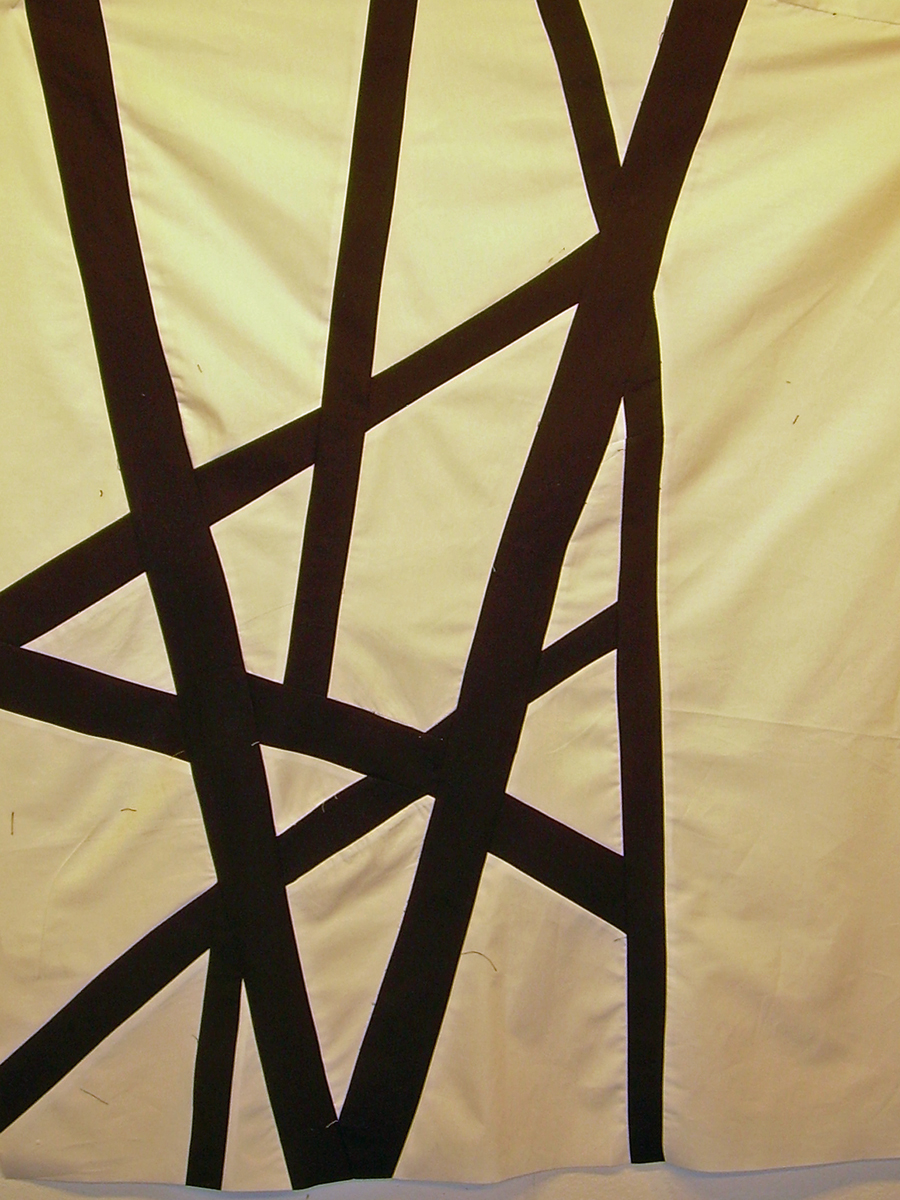
I sewed it together – black and white, piece by piece, trying to make it as close to the pinned-up design as possible. There were some obvious errors. One black line didn’t continue straight through a small white triangle; another black line didn’t match up at the crossings. Although I’d intended the lines to be relatively straight (I don’t use a ruler), some were obviously curved.

Sticks - Initial Design - Sewn

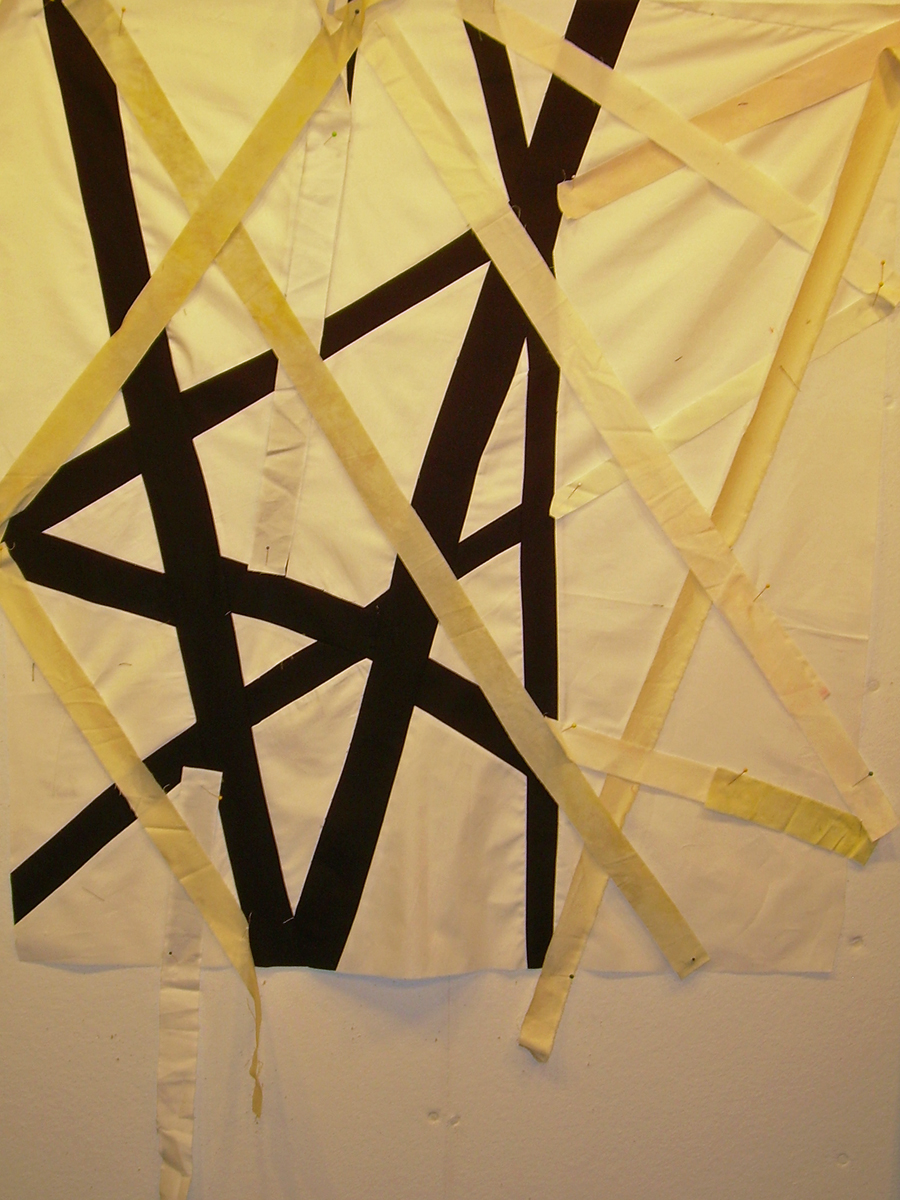
Because the high contrast of black on white did not meet one of the requirements of our figure ground exercise – i.e. to bring tertiary lines into the design – I layered some cream-colored strips on top to create new configurations. It looked even more like Moje’s “Portland Panels.”

Sticks - Design with Tertiary Lines

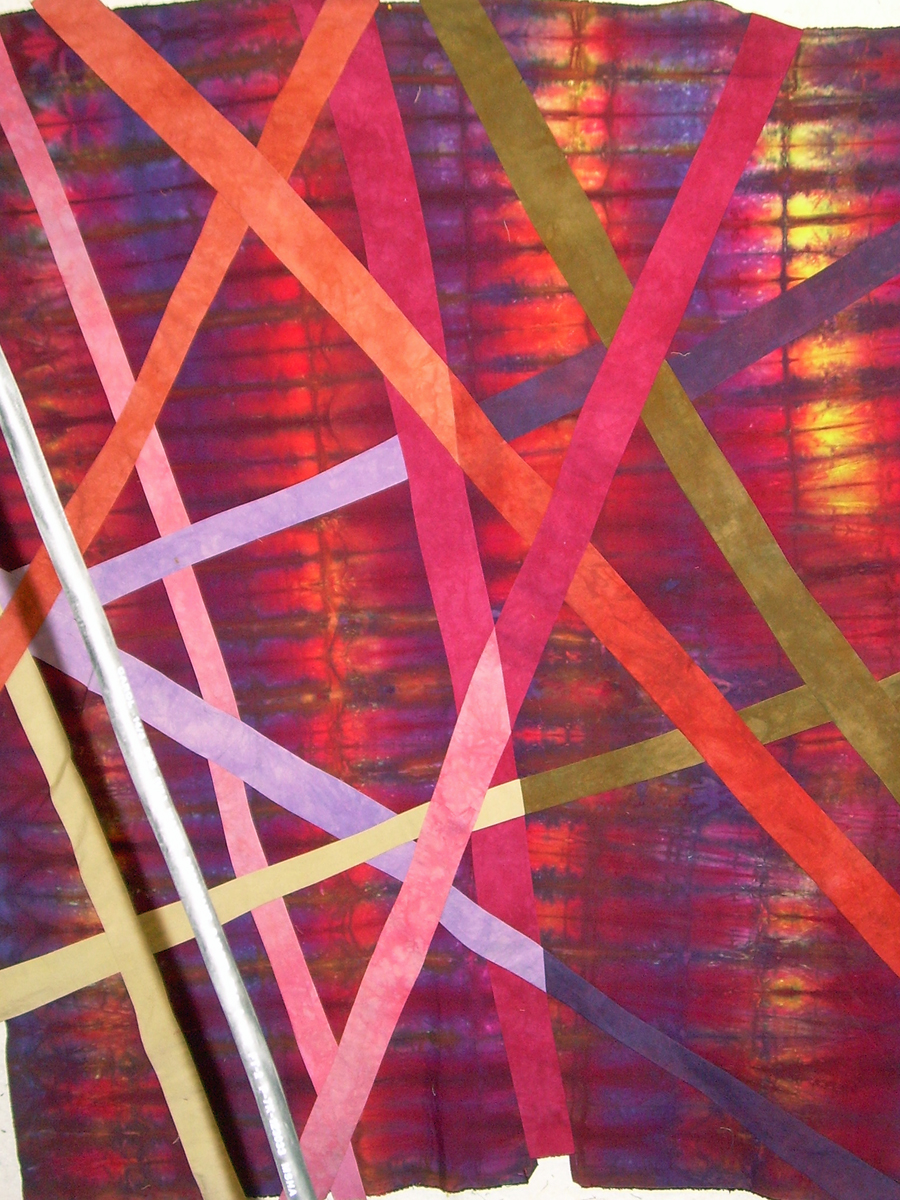
I then interpreted it in color using a pattern-dyed piece of fabric for the background and solid-colored strips on top in complementary colors. At first my strips were too close to the same value, so I made them lighter for the “black” lines and of similar value for the tertiary lines. Then I sewed it together piece by piece, tediously matching intersections as closely as possible. It wasn’t easy, because I didn’t have any extra background fabric. The whole piece came out quite skewed. It was also quite structured – but I pushed on.

Sticks - #1

I pieced the design again used another pattern-dyed piece for the background. I cut the strips more freely and inserted them into the length (or width) of the background, cutting through previously sewn strips to make the intersections. It was easier to construct, and, amazingly, the strips matched up even better than doing it piece by piece. I also eliminated some strips so that I didn’t break up the patterned background. This was much more fun!

Sticks - #2

Now I’m thinking of other variations – strips appliquéd on top; strips made up of smaller, collaged pieces or strip pieced like Moje’s work; no strips and slashing and sewing the background together instead; moving color across the piece; making a piece out of only the strips with no background. It’s beginning to look like a series!

So a couple of nights ago, I dreamed about the series and came up with a title: “Sticks.” Possibilities and images are filling my head – Pick-Up Sticks; FiddleSticks; Sticks and Stones; A Sticky Situation; Stick Around; Pile of Sticks; A Stick-ler for … ; Stick Up; Stick to Me Like Glue; Stick It to ‘Em; Broken Sticks; Stick Figures; Walking Sticks; DrumSticks; ChopSticks – to name a few.

I’ll keep you updated on the “Stick” series in future blog posts. In the meantime, keep dreaming and designing – and having fun!